
Celebrating research, representation and queer joy
Five award recipients explored new possibilities for queer research, from mental health and affirmative care to community archives and video game representation.
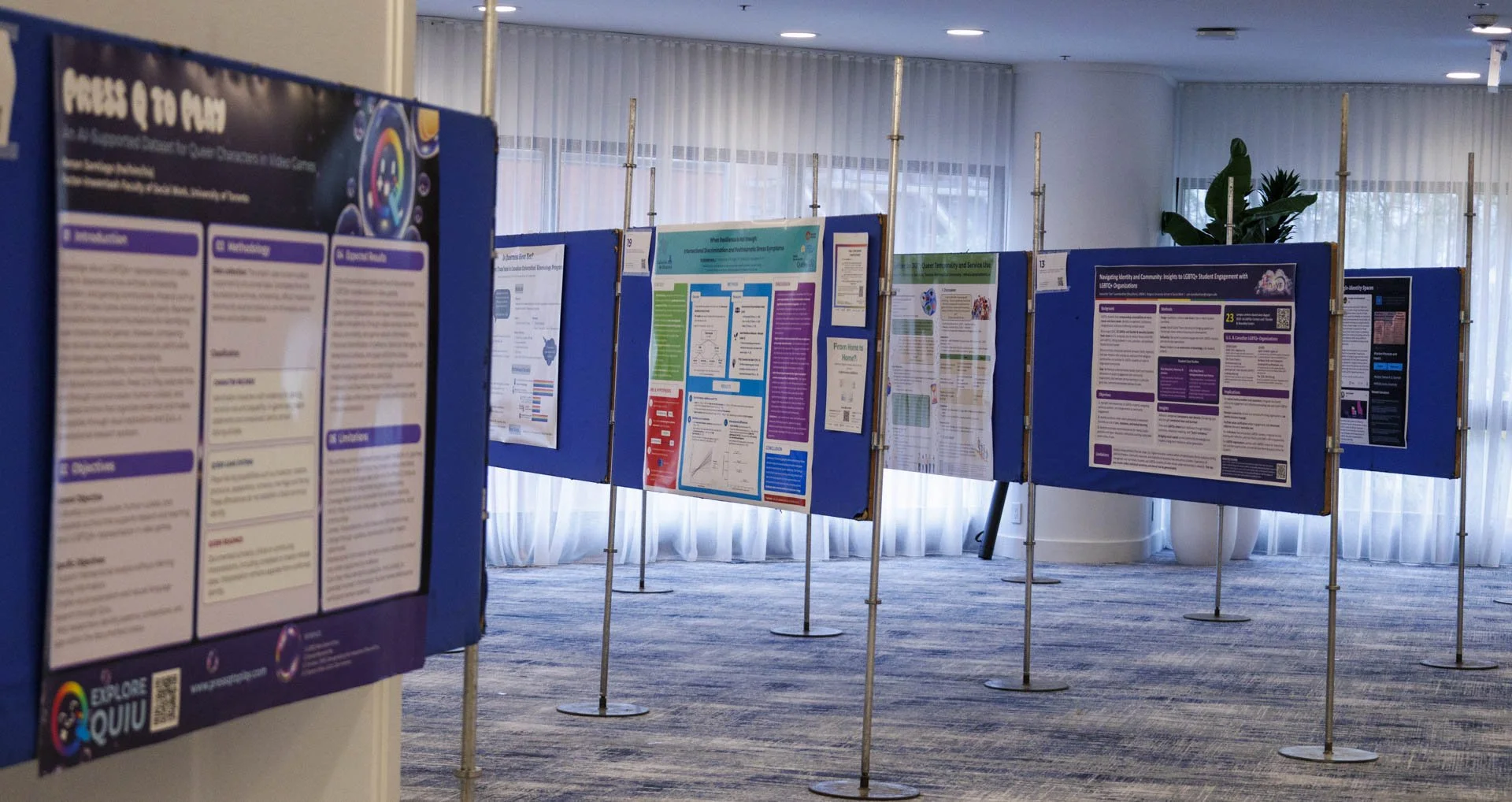
Held on October 2 at the Chelsea Hotel in Toronto, INQYR’s Beyond Limits 2026 conference brought together research, community knowledge, and queer joy. Alongside a keynote by Dr. Ilan H. Meyer, presentations and an INQYR creative showcase, five Poster Awards recognized research excellence, impact, design, joy and work that pushes beyond traditional research boundaries.

Esteban Leonardo Jiménez Rivagorza (he/him)
The Beyond Limits Award

Jiménez-Rivagorza, of the National Autonomous University of Mexico, examined patterns of substance use and health indicators among gay, bisexual and other men who have sex with men in Mexico. His latent class analysis identified four distinct patterns, showing why care should account for different experiences rather than assume a uniform relationship between substance use and health.
Some patterns coexisted with higher perceived social support, challenging interpretations focused exclusively on risk and highlighting the social contexts surrounding substance use.
When I analyze the data and find something that can help to create or improve the existing mental health programs, especially among Mexican LGBTQ+ persons, I really feel alive.
— Esteban Leonardo Jiménez-Rivagorza
Continuing, he said, “As a Mexican, I'm proud to bring this award back to my country, but of course, I also acknowledge the great work everyone did.”
Thea Weaver (they/them)
The Joy Award

Thea Weaver’s On Paper, In Practice: Archiving Queer Scarborough explored how art, storytelling and archiving can support belonging among 2SLGBTQ+ youth in Scarborough. The community-engaged project documents queer experiences in a place often overlooked by accounts centred on downtown Toronto.
Through postcard-making, collage and painting workshops, young people created artwork and shared experiences that form a growing archive. These materials show how queer youth of colour cultivate resilience and belonging amid spatial, racial and socioeconomic marginalization. The project approaches creative archiving as a practice of community care, preserving everyday experiences while making room for identity and possibility.
For Weaver, creating accessible queer arts programming also helped clarify a future career. “I always wished I had something similar, growing up isolated in Ontario suburbs,” they said, explaining, “It is with Queer Scarborough that I found what I want to pursue as a career: queer public programming through libraries!”
The research also opened an interest in archives. As Weaver put it: “Keeping our work accessible will always be the goal.”
Receiving the Joy Award felt especially fitting.
Really, queer joy and resilience is what Queer Scarborough is all about.
— Thea Weaver
“It felt right, for this work to win such a fitting title!” Weaver added.
Renan Santiago (he/him)
The Yabu Pushelberg Design Award

Renan Santiago’s Press Q to Play: An AI-Supported Dataset for Queer Characters in Video Games brought questions of representation into the digital worlds where queer people play, connect and encounter exclusion.
The project proposes a searchable dataset and an AI-supported tool, Quiu, to complement existing queer video game archives. Its human-led approach uses manually gathered information and aims to support analysis across dimensions including race, class, disability, cultural context, and narrative role. The intended resource would help researchers, educators, students and community users explore queer representation across gaming history.
“I've always had difficulty feeling represented in characters, or even in online multiplayer games. The environment ended up being very hostile,” Santiago said. His experience as a queer player, alongside debate about AI ethics, motivated him to explore a constructive application that could support representation and contribute to Queer Game Studies.
The design award added a personal connection.
My work involves a lot of design, and George and Glenn are very talented, so having my work associated, even symbolically, with this great reference was wonderful.
— Renan Santiago
In addition to these awards, two other researchers were recognized for their contributions to queer research.
Gio Iacono (he/him)
The Impact Award

Gio Iacono, of the University of Connecticut, received the Impact Award for a U.S. national survey of social workers’ preparedness for affirmative practice with 2SLGBTQIA+ youth. Drawing on responses from 10,596 social workers, the study identified gaps in perceived preparedness and opportunities to strengthen professional education and support for practitioners working with queer young people.
“This work is meaningful to me because it highlights gaps in social workers’ preparedness to provide affirmative care to 2SLGBTQIA+ young people,” Iacono said. He emphasized its actionable recommendations for MSW education and professional development, alongside the need to address institutional and organizational barriers to affirming care.
Receiving the Impact Award was especially meaningful because it recognized the potential for this research to inform social work practice and community work with 2SLGBTQIA+ communities.
— Gio Iacono
Having that potential acknowledged by a community committed to queer young people’s joy and resilience made the recognition particularly encouraging.
Chase Staras (he/him)
The Research Excellence Award

Chase Staras, of University College London, received the Research Excellence Award for a mixed-methods study of gender congruence, body image and quality of life in trans men. Combining surveys and interviews, the research highlighted the importance of gender affirmation, body neutrality, and valuing what bodies can do when understanding well-being.
My research on body image in trans men is about seeing trans people as whole people, not only through the lens of being trans.
— Chase Staras
“They deserve research across every part of their lives, including areas like body image that matter just as much to their health and wellbeing,” Staras added.
The award also carried particular significance for Staras: “In the current UK climate, trans research is often overlooked or treated as less rigorous or less of a priority. It meant a great deal to see the quality of this work recognised with the Research Excellence Award.”
Together, the five award recipients reflected the breadth of research shared at Beyond Limits 2026 and the personal commitments behind it. Their projects connected questions of care and representation with the everyday experiences of queer communities. As the conference came to a close, these contributions offered directions for future research and practice, while celebrating the creativity, dedication and queer joy that brought participants together.